Your ability to collaborate is also hugely important in making a name for yourself as a legitimate singer. If people don't like working with you, for whatever reason, you will not get work. Especially in this day in age when there are more singers trying to sing professionally than ever before; it isn't good enough to be "fine" You have to be exciting to work with in order for people to want to work with you. You must have a positive attitude, be able to admit fallibility and admit your faults. Admitting your faults shows that you come from a position of strength and other people don't want to work with someone who masks their insecurities with false confidence and arrogance.
Think about who you really enjoy working with. Why do you enjoy it? What do they offer you that keeps you coming back?
Saturday, July 28, 2012

Friday, July 27, 2012
Great Singers on Great singing
Great Singers on Great Singing is a book that every serious singer should own. It contains the wisdom of several famous opera singers from Marilyn Horne to Placido Domingo. They all offer their advice on what healthy singing is.
Today's Advice. http://www.amazon.com/Great-Singers-Singing-Interviews-Technique/dp/0879100257
Read it :)
Larz the Larynx
Today's Advice. http://www.amazon.com/Great-Singers-Singing-Interviews-Technique/dp/0879100257
Read it :)
Larz the Larynx
Tuesday, July 24, 2012
one "easy" trick to improve your singing forever
Being a type A can be a huge blessing for a singer. It can help make that person more goal oriented, learn roles more quickly, meet deadlines, network more effectively. The ability to break down any large task into smaller components is a good one. however there is a problem with being a type A and a singer. Type A's are often results oriented, and quite impatient. But learning to sing is a process and doesn't happen overnight. Marketing claims of "learn to sing in 60 days!" or even the title of this post can grant huge promises and almost zero returns.
Truthfully the easiest way to learn to sing is to work as hard as you possibly can, systematically eliminating extraneous tensions and extra brain noise that is holding you back from achieving your goals. Yes, the goal is to achieve the best vocal quality you can, but you cannot achieve that if all of your measurements are qualitative. You must have quantitative goals that can be easily measured for instance,
your goals might be:
Be able to hiss for 20 seconds continuously
be able to suspend your breath with 10 seconds without closing the vocal folds
be able to hit "note x" without flexing the sternoclaudomastoids or allowing the larynx to raise
don't allow any glottal offsets
These things can be easily measured. If you give yourself goals like these it is not hard to know where you stand in terms of progress.
However if your goals are, "I want my high C to sound good" or " Sound better" or "feel this emotion here" Your ability to measure the result is severely hindered and thus your ability to know your progress is limited.
Quality CAN be quantified
Next time you practice, measure yourself, that way you can be sure you are growing.
Keep growing
Larz the Larynx
"Life is easy when you live it the hard way"-Dave Kekich
Truthfully the easiest way to learn to sing is to work as hard as you possibly can, systematically eliminating extraneous tensions and extra brain noise that is holding you back from achieving your goals. Yes, the goal is to achieve the best vocal quality you can, but you cannot achieve that if all of your measurements are qualitative. You must have quantitative goals that can be easily measured for instance,
your goals might be:
Be able to hiss for 20 seconds continuously
be able to suspend your breath with 10 seconds without closing the vocal folds
be able to hit "note x" without flexing the sternoclaudomastoids or allowing the larynx to raise
don't allow any glottal offsets
These things can be easily measured. If you give yourself goals like these it is not hard to know where you stand in terms of progress.
However if your goals are, "I want my high C to sound good" or " Sound better" or "feel this emotion here" Your ability to measure the result is severely hindered and thus your ability to know your progress is limited.
Quality CAN be quantified
Next time you practice, measure yourself, that way you can be sure you are growing.
Keep growing
Larz the Larynx
"Life is easy when you live it the hard way"-Dave Kekich
Monday, July 23, 2012
Am I in good vocal shape or am I just an idiot?
This is a question that I ask myself often? And I'm honestly never sure of the answer. There have been days when I have sung for 3-4 hours straight through too prove to myself I could make it through a role. This is bad.
It can be really easy to avoid listening to your body telling you to STOP especially as your technique is improving and you don't feel like you HAVE to stop, only that you probably should. This is a very important crossroads for many young singers. What is the Limit? Am I there yet?
The honest answer is that, if you think you SHOULD stop, and you notice anything not working exactly as usual then you NEED to stop. Otherwise you could be training in bad habits that will take longer to eradicate than to implement. This doesn't mean don't practice hard, and don't push yourself, it just means that you need to know yourself. Push yourself by focusing on form, when the form deteriorates, it's time to stop. It's that simple.
It can be really easy to avoid listening to your body telling you to STOP especially as your technique is improving and you don't feel like you HAVE to stop, only that you probably should. This is a very important crossroads for many young singers. What is the Limit? Am I there yet?
The honest answer is that, if you think you SHOULD stop, and you notice anything not working exactly as usual then you NEED to stop. Otherwise you could be training in bad habits that will take longer to eradicate than to implement. This doesn't mean don't practice hard, and don't push yourself, it just means that you need to know yourself. Push yourself by focusing on form, when the form deteriorates, it's time to stop. It's that simple.
Sunday, July 22, 2012
Jaw tension? Try stretching.
Jaw tension is a common problem in the world of singing, it can be observed often. Singers who change pitch and move their jaw at the same time, or singers who have their jaw locked in one position for the duration of phonation. Some singers even develop TMJ dysfunction which causes the jaw to crackle or pop when it is opened. It is important for the student of singing to manage and release this tension.
The first step in releasing tension is a muscle is becoming aware of its existence and that you have your brain wired to send "contract" signals even when you aren't thinking about it. The masseters are the muscles used to close the jaw. If you are experiencing tension in this muscle, stretch it. How? Open your mouth wide, really wide. Try to fit 3 knuckles in your mouth. Stretching is a great way to teach yourself to stop sending contract signals, because in order to elongate the muscle you HAVE to stop contracting it.
Another way to become aware of tension in your masseters is by chewing, especially when singing. Humming while making a chewing movement allows you to dissociate the singing neural impulse and the masseter neural impulse. It's sort of like rubbing your belly and patting your head. The two processes don't have anything to do with one another so you have to train your brain to keep them separate, or else you end up rubbing your head and patting your belly, and no one wants that. It just looks silly.
It is normal also for your jaw muscles to be sore the day after stretching, just like any other muscles get sore after a good stretching, so don't worry if putting a few knuckles in your mouth causes moderate soreness.
To your success,
Larz the Larynx
The first step in releasing tension is a muscle is becoming aware of its existence and that you have your brain wired to send "contract" signals even when you aren't thinking about it. The masseters are the muscles used to close the jaw. If you are experiencing tension in this muscle, stretch it. How? Open your mouth wide, really wide. Try to fit 3 knuckles in your mouth. Stretching is a great way to teach yourself to stop sending contract signals, because in order to elongate the muscle you HAVE to stop contracting it.
Another way to become aware of tension in your masseters is by chewing, especially when singing. Humming while making a chewing movement allows you to dissociate the singing neural impulse and the masseter neural impulse. It's sort of like rubbing your belly and patting your head. The two processes don't have anything to do with one another so you have to train your brain to keep them separate, or else you end up rubbing your head and patting your belly, and no one wants that. It just looks silly.
It is normal also for your jaw muscles to be sore the day after stretching, just like any other muscles get sore after a good stretching, so don't worry if putting a few knuckles in your mouth causes moderate soreness.
To your success,
Larz the Larynx
Saturday, July 21, 2012
Appoggio trouble- here are some tools.
There are several things you can do to make sure you are using the appoggio method of breath support.
1. Hissing- A staple in the Classical singing tradition, hissing completely isolates the breath coordination from all other aspects of singing. This is the starting place for anyone who really wants to achieve a level of elite singing. The closed mouth and high pressure [s] consonant decrease the amount of air flow that is possible which increases the resistance. This allows you to feel the contraction of your abs to a greater extent than is possible in singing. If you really want to feel it, try using [f] or [sh] .. F increases the resistance even more and is good if you are having a hard time with [s]. I had to start with [f] and it was life changing.
If you are pretty good with [s], try [sh] it's quite a challenge because so much more air can pass through. It's hard to keep your ribs from collapsing.
2. Singing with straws. Grab some coffee straws and begin singing into them. In a way singing into a straw is similar to hissing- it increases the amount of resistance and removes certain aspects of the singing equation. Using straws removes articulation and vowel formation from the singing process temporarily and allows you to focus on the coordination between the breath and the folds. Singing into the straws forces you to have your mouth basically closed and only lets a small amount of air through the straw, this increases the amount of resistance that you have to push against with your support mechanism. You should really feel your abs working and your ribs wanting to stay expanded. Singing this way truly illuminates whether or not your singing is connected to your breath. It helps you negotiate onsets as well.
3. The Singing Belt- you can either buy a "singing belt" or make one yourself out of elastic bands. The singing belt is a product that fits much like a belt, except that you wear it around your mid torso rather than at your waist. The purpose of the singing belt is to monitor your epigastric expansion. A person wearing the singing belt would inhale and then tighten the belt so it fits when they are fully inhaled, then attempt to keep their ribs from collapsing while singing, the belt helps by making a person more aware of that part of their body. If the person imagines pushing against it that can sometimes help. When incorrect support techniques are used the belt will fall. Simply put, keep belt in place, and you are doing it right
Make sure that while doing these excersizes you are watching to make sure that you aren't flexing any other muscles that aren't involved with the process. Isolation is your friend.
Cheers,
Larz the Larynx
1. Hissing- A staple in the Classical singing tradition, hissing completely isolates the breath coordination from all other aspects of singing. This is the starting place for anyone who really wants to achieve a level of elite singing. The closed mouth and high pressure [s] consonant decrease the amount of air flow that is possible which increases the resistance. This allows you to feel the contraction of your abs to a greater extent than is possible in singing. If you really want to feel it, try using [f] or [sh] .. F increases the resistance even more and is good if you are having a hard time with [s]. I had to start with [f] and it was life changing.
If you are pretty good with [s], try [sh] it's quite a challenge because so much more air can pass through. It's hard to keep your ribs from collapsing.
2. Singing with straws. Grab some coffee straws and begin singing into them. In a way singing into a straw is similar to hissing- it increases the amount of resistance and removes certain aspects of the singing equation. Using straws removes articulation and vowel formation from the singing process temporarily and allows you to focus on the coordination between the breath and the folds. Singing into the straws forces you to have your mouth basically closed and only lets a small amount of air through the straw, this increases the amount of resistance that you have to push against with your support mechanism. You should really feel your abs working and your ribs wanting to stay expanded. Singing this way truly illuminates whether or not your singing is connected to your breath. It helps you negotiate onsets as well.
3. The Singing Belt- you can either buy a "singing belt" or make one yourself out of elastic bands. The singing belt is a product that fits much like a belt, except that you wear it around your mid torso rather than at your waist. The purpose of the singing belt is to monitor your epigastric expansion. A person wearing the singing belt would inhale and then tighten the belt so it fits when they are fully inhaled, then attempt to keep their ribs from collapsing while singing, the belt helps by making a person more aware of that part of their body. If the person imagines pushing against it that can sometimes help. When incorrect support techniques are used the belt will fall. Simply put, keep belt in place, and you are doing it right
Make sure that while doing these excersizes you are watching to make sure that you aren't flexing any other muscles that aren't involved with the process. Isolation is your friend.
Cheers,
Larz the Larynx
Friday, July 20, 2012
Why making weird faces is a bad idea: The end of the demented bunny rabit

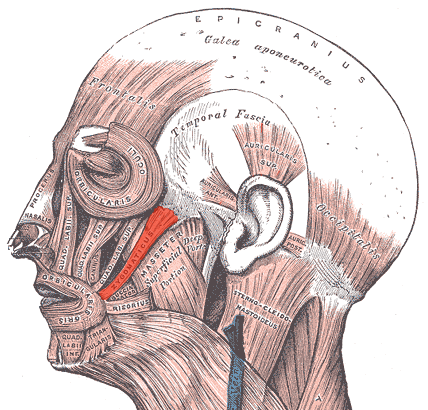
Have you ever had a voice teacher tell you to smile as you approach the top, or even to make the " crazy bunny rabbit face"? Chances are that you have. What happens when you "smile" at an anatomical level is that you are flexing you Zygomatic muscles (highlighted in red) Unfortunately, these muscles have nothing to do with producing sound and when flexed have the negative side effect of spreading your lips thereby spreading the sound. So then, why do so many voice teachers encourage this practice?
Try this: at your computer, attempt to curl down just your pinky finger. Most likely you found that your ring finger also wanted to curl down. Now try this. Curl down your pinky finger and intentionally simultaneously curl down your ring finger. That was much easier wasn't it?
The flexing of the Zygomatic muscles has a similar effect on your soft palate as your ring finger has on your pinky finger.
When the brain sends signals to the Zygomatic muscles, it also sends signals to the soft palate. So the use of this technique can come in handy for sure, as it helps you keep your soft palate raised. But, here i where it has it's downfall. The flexing of this muscle, spreads your sound, AND makes you look like a constipated goat. This trick is simiply that, a trick. It gives you the illusion of control over your voice when really you still don't know how to keep your soft palate raised. It also severely limits your ability to be expressive with your face, every facial position begins to look demented at least and hideous at best.
IF this technique was the ONLY way to make sure your soft palate stayed raised, then I would understand its practice but it isn't. With practice you can teach yourself to keep your soft palate raised without engaging the zygomatic muscles. just like you can teach yourself to curl only your pinky, or make the "live long and prosper" vulcan hand gesture.

Why make that crazy face, when you can achieve the same result without it AND not spread the sound at the same time!
Live Long and Prosper!
Larz the Larynx
Live Long and Prosper!
Larz the Larynx
Subscribe to:
Posts (Atom)