Your ability to collaborate is also hugely important in making a name for yourself as a legitimate singer. If people don't like working with you, for whatever reason, you will not get work. Especially in this day in age when there are more singers trying to sing professionally than ever before; it isn't good enough to be "fine" You have to be exciting to work with in order for people to want to work with you. You must have a positive attitude, be able to admit fallibility and admit your faults. Admitting your faults shows that you come from a position of strength and other people don't want to work with someone who masks their insecurities with false confidence and arrogance.
Think about who you really enjoy working with. Why do you enjoy it? What do they offer you that keeps you coming back?
Saturday, July 28, 2012

Friday, July 27, 2012
Great Singers on Great singing
Great Singers on Great Singing is a book that every serious singer should own. It contains the wisdom of several famous opera singers from Marilyn Horne to Placido Domingo. They all offer their advice on what healthy singing is.
Today's Advice. http://www.amazon.com/Great-Singers-Singing-Interviews-Technique/dp/0879100257
Read it :)
Larz the Larynx
Today's Advice. http://www.amazon.com/Great-Singers-Singing-Interviews-Technique/dp/0879100257
Read it :)
Larz the Larynx
Tuesday, July 24, 2012
one "easy" trick to improve your singing forever
Being a type A can be a huge blessing for a singer. It can help make that person more goal oriented, learn roles more quickly, meet deadlines, network more effectively. The ability to break down any large task into smaller components is a good one. however there is a problem with being a type A and a singer. Type A's are often results oriented, and quite impatient. But learning to sing is a process and doesn't happen overnight. Marketing claims of "learn to sing in 60 days!" or even the title of this post can grant huge promises and almost zero returns.
Truthfully the easiest way to learn to sing is to work as hard as you possibly can, systematically eliminating extraneous tensions and extra brain noise that is holding you back from achieving your goals. Yes, the goal is to achieve the best vocal quality you can, but you cannot achieve that if all of your measurements are qualitative. You must have quantitative goals that can be easily measured for instance,
your goals might be:
Be able to hiss for 20 seconds continuously
be able to suspend your breath with 10 seconds without closing the vocal folds
be able to hit "note x" without flexing the sternoclaudomastoids or allowing the larynx to raise
don't allow any glottal offsets
These things can be easily measured. If you give yourself goals like these it is not hard to know where you stand in terms of progress.
However if your goals are, "I want my high C to sound good" or " Sound better" or "feel this emotion here" Your ability to measure the result is severely hindered and thus your ability to know your progress is limited.
Quality CAN be quantified
Next time you practice, measure yourself, that way you can be sure you are growing.
Keep growing
Larz the Larynx
"Life is easy when you live it the hard way"-Dave Kekich
Truthfully the easiest way to learn to sing is to work as hard as you possibly can, systematically eliminating extraneous tensions and extra brain noise that is holding you back from achieving your goals. Yes, the goal is to achieve the best vocal quality you can, but you cannot achieve that if all of your measurements are qualitative. You must have quantitative goals that can be easily measured for instance,
your goals might be:
Be able to hiss for 20 seconds continuously
be able to suspend your breath with 10 seconds without closing the vocal folds
be able to hit "note x" without flexing the sternoclaudomastoids or allowing the larynx to raise
don't allow any glottal offsets
These things can be easily measured. If you give yourself goals like these it is not hard to know where you stand in terms of progress.
However if your goals are, "I want my high C to sound good" or " Sound better" or "feel this emotion here" Your ability to measure the result is severely hindered and thus your ability to know your progress is limited.
Quality CAN be quantified
Next time you practice, measure yourself, that way you can be sure you are growing.
Keep growing
Larz the Larynx
"Life is easy when you live it the hard way"-Dave Kekich
Monday, July 23, 2012
Am I in good vocal shape or am I just an idiot?
This is a question that I ask myself often? And I'm honestly never sure of the answer. There have been days when I have sung for 3-4 hours straight through too prove to myself I could make it through a role. This is bad.
It can be really easy to avoid listening to your body telling you to STOP especially as your technique is improving and you don't feel like you HAVE to stop, only that you probably should. This is a very important crossroads for many young singers. What is the Limit? Am I there yet?
The honest answer is that, if you think you SHOULD stop, and you notice anything not working exactly as usual then you NEED to stop. Otherwise you could be training in bad habits that will take longer to eradicate than to implement. This doesn't mean don't practice hard, and don't push yourself, it just means that you need to know yourself. Push yourself by focusing on form, when the form deteriorates, it's time to stop. It's that simple.
It can be really easy to avoid listening to your body telling you to STOP especially as your technique is improving and you don't feel like you HAVE to stop, only that you probably should. This is a very important crossroads for many young singers. What is the Limit? Am I there yet?
The honest answer is that, if you think you SHOULD stop, and you notice anything not working exactly as usual then you NEED to stop. Otherwise you could be training in bad habits that will take longer to eradicate than to implement. This doesn't mean don't practice hard, and don't push yourself, it just means that you need to know yourself. Push yourself by focusing on form, when the form deteriorates, it's time to stop. It's that simple.
Sunday, July 22, 2012
Jaw tension? Try stretching.
Jaw tension is a common problem in the world of singing, it can be observed often. Singers who change pitch and move their jaw at the same time, or singers who have their jaw locked in one position for the duration of phonation. Some singers even develop TMJ dysfunction which causes the jaw to crackle or pop when it is opened. It is important for the student of singing to manage and release this tension.
The first step in releasing tension is a muscle is becoming aware of its existence and that you have your brain wired to send "contract" signals even when you aren't thinking about it. The masseters are the muscles used to close the jaw. If you are experiencing tension in this muscle, stretch it. How? Open your mouth wide, really wide. Try to fit 3 knuckles in your mouth. Stretching is a great way to teach yourself to stop sending contract signals, because in order to elongate the muscle you HAVE to stop contracting it.
Another way to become aware of tension in your masseters is by chewing, especially when singing. Humming while making a chewing movement allows you to dissociate the singing neural impulse and the masseter neural impulse. It's sort of like rubbing your belly and patting your head. The two processes don't have anything to do with one another so you have to train your brain to keep them separate, or else you end up rubbing your head and patting your belly, and no one wants that. It just looks silly.
It is normal also for your jaw muscles to be sore the day after stretching, just like any other muscles get sore after a good stretching, so don't worry if putting a few knuckles in your mouth causes moderate soreness.
To your success,
Larz the Larynx
The first step in releasing tension is a muscle is becoming aware of its existence and that you have your brain wired to send "contract" signals even when you aren't thinking about it. The masseters are the muscles used to close the jaw. If you are experiencing tension in this muscle, stretch it. How? Open your mouth wide, really wide. Try to fit 3 knuckles in your mouth. Stretching is a great way to teach yourself to stop sending contract signals, because in order to elongate the muscle you HAVE to stop contracting it.
Another way to become aware of tension in your masseters is by chewing, especially when singing. Humming while making a chewing movement allows you to dissociate the singing neural impulse and the masseter neural impulse. It's sort of like rubbing your belly and patting your head. The two processes don't have anything to do with one another so you have to train your brain to keep them separate, or else you end up rubbing your head and patting your belly, and no one wants that. It just looks silly.
It is normal also for your jaw muscles to be sore the day after stretching, just like any other muscles get sore after a good stretching, so don't worry if putting a few knuckles in your mouth causes moderate soreness.
To your success,
Larz the Larynx
Saturday, July 21, 2012
Appoggio trouble- here are some tools.
There are several things you can do to make sure you are using the appoggio method of breath support.
1. Hissing- A staple in the Classical singing tradition, hissing completely isolates the breath coordination from all other aspects of singing. This is the starting place for anyone who really wants to achieve a level of elite singing. The closed mouth and high pressure [s] consonant decrease the amount of air flow that is possible which increases the resistance. This allows you to feel the contraction of your abs to a greater extent than is possible in singing. If you really want to feel it, try using [f] or [sh] .. F increases the resistance even more and is good if you are having a hard time with [s]. I had to start with [f] and it was life changing.
If you are pretty good with [s], try [sh] it's quite a challenge because so much more air can pass through. It's hard to keep your ribs from collapsing.
2. Singing with straws. Grab some coffee straws and begin singing into them. In a way singing into a straw is similar to hissing- it increases the amount of resistance and removes certain aspects of the singing equation. Using straws removes articulation and vowel formation from the singing process temporarily and allows you to focus on the coordination between the breath and the folds. Singing into the straws forces you to have your mouth basically closed and only lets a small amount of air through the straw, this increases the amount of resistance that you have to push against with your support mechanism. You should really feel your abs working and your ribs wanting to stay expanded. Singing this way truly illuminates whether or not your singing is connected to your breath. It helps you negotiate onsets as well.
3. The Singing Belt- you can either buy a "singing belt" or make one yourself out of elastic bands. The singing belt is a product that fits much like a belt, except that you wear it around your mid torso rather than at your waist. The purpose of the singing belt is to monitor your epigastric expansion. A person wearing the singing belt would inhale and then tighten the belt so it fits when they are fully inhaled, then attempt to keep their ribs from collapsing while singing, the belt helps by making a person more aware of that part of their body. If the person imagines pushing against it that can sometimes help. When incorrect support techniques are used the belt will fall. Simply put, keep belt in place, and you are doing it right
Make sure that while doing these excersizes you are watching to make sure that you aren't flexing any other muscles that aren't involved with the process. Isolation is your friend.
Cheers,
Larz the Larynx
1. Hissing- A staple in the Classical singing tradition, hissing completely isolates the breath coordination from all other aspects of singing. This is the starting place for anyone who really wants to achieve a level of elite singing. The closed mouth and high pressure [s] consonant decrease the amount of air flow that is possible which increases the resistance. This allows you to feel the contraction of your abs to a greater extent than is possible in singing. If you really want to feel it, try using [f] or [sh] .. F increases the resistance even more and is good if you are having a hard time with [s]. I had to start with [f] and it was life changing.
If you are pretty good with [s], try [sh] it's quite a challenge because so much more air can pass through. It's hard to keep your ribs from collapsing.
2. Singing with straws. Grab some coffee straws and begin singing into them. In a way singing into a straw is similar to hissing- it increases the amount of resistance and removes certain aspects of the singing equation. Using straws removes articulation and vowel formation from the singing process temporarily and allows you to focus on the coordination between the breath and the folds. Singing into the straws forces you to have your mouth basically closed and only lets a small amount of air through the straw, this increases the amount of resistance that you have to push against with your support mechanism. You should really feel your abs working and your ribs wanting to stay expanded. Singing this way truly illuminates whether or not your singing is connected to your breath. It helps you negotiate onsets as well.
3. The Singing Belt- you can either buy a "singing belt" or make one yourself out of elastic bands. The singing belt is a product that fits much like a belt, except that you wear it around your mid torso rather than at your waist. The purpose of the singing belt is to monitor your epigastric expansion. A person wearing the singing belt would inhale and then tighten the belt so it fits when they are fully inhaled, then attempt to keep their ribs from collapsing while singing, the belt helps by making a person more aware of that part of their body. If the person imagines pushing against it that can sometimes help. When incorrect support techniques are used the belt will fall. Simply put, keep belt in place, and you are doing it right
Make sure that while doing these excersizes you are watching to make sure that you aren't flexing any other muscles that aren't involved with the process. Isolation is your friend.
Cheers,
Larz the Larynx
Friday, July 20, 2012
Why making weird faces is a bad idea: The end of the demented bunny rabit

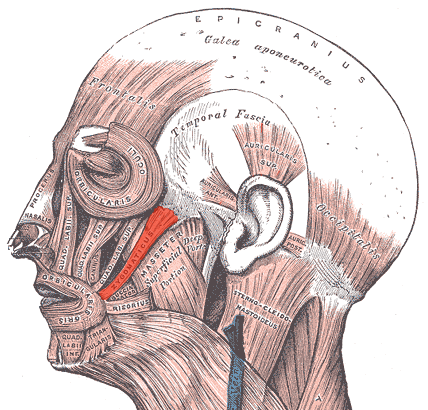
Have you ever had a voice teacher tell you to smile as you approach the top, or even to make the " crazy bunny rabbit face"? Chances are that you have. What happens when you "smile" at an anatomical level is that you are flexing you Zygomatic muscles (highlighted in red) Unfortunately, these muscles have nothing to do with producing sound and when flexed have the negative side effect of spreading your lips thereby spreading the sound. So then, why do so many voice teachers encourage this practice?
Try this: at your computer, attempt to curl down just your pinky finger. Most likely you found that your ring finger also wanted to curl down. Now try this. Curl down your pinky finger and intentionally simultaneously curl down your ring finger. That was much easier wasn't it?
The flexing of the Zygomatic muscles has a similar effect on your soft palate as your ring finger has on your pinky finger.
When the brain sends signals to the Zygomatic muscles, it also sends signals to the soft palate. So the use of this technique can come in handy for sure, as it helps you keep your soft palate raised. But, here i where it has it's downfall. The flexing of this muscle, spreads your sound, AND makes you look like a constipated goat. This trick is simiply that, a trick. It gives you the illusion of control over your voice when really you still don't know how to keep your soft palate raised. It also severely limits your ability to be expressive with your face, every facial position begins to look demented at least and hideous at best.
IF this technique was the ONLY way to make sure your soft palate stayed raised, then I would understand its practice but it isn't. With practice you can teach yourself to keep your soft palate raised without engaging the zygomatic muscles. just like you can teach yourself to curl only your pinky, or make the "live long and prosper" vulcan hand gesture.

Why make that crazy face, when you can achieve the same result without it AND not spread the sound at the same time!
Live Long and Prosper!
Larz the Larynx
Live Long and Prosper!
Larz the Larynx
Thursday, July 19, 2012
Can you learn to sing?
Some people are under the impression that only a select few are given the gift of singing, and that if one is born without that gift, then he will never sing. This is complete hogwash.
If you can speak, then you can sing. If you have the ability to close your vocal folds and blow air through them to create a sound, then you can sing.
This is the sounds your vocal cords make on their own
http://www.youtube.com/watch?v=9SmyLshMzR4
or this
http://www.youtube.com/watch?v=k0rMnEs_VNo
All the rest is a change in the space around the vocal folds. Learning to manipulate the space, is a process that takes time, much like Building muscle, or learning to ride a unicycle.
The truth is, that if you are willing to work at it, and work hard, then you can sing. There is no quick fix, and frankly, if there was, singing wouldn't be worth it. There is so much more reward to having a skill when you can look back and realize that all the blood sweat and tears were worth something. When you turn your trials and tribulations into human triumph.
If you aren't happy with the sounds you are making right now, that's OK, just keep practicing, keep your focus, and stay the path. It's OK if you lose your way, as long as you keep moving.
Practice Practice Practice!
Larz the Larynx
If you can speak, then you can sing. If you have the ability to close your vocal folds and blow air through them to create a sound, then you can sing.
This is the sounds your vocal cords make on their own
http://www.youtube.com/watch?v=9SmyLshMzR4
or this
http://www.youtube.com/watch?v=k0rMnEs_VNo
All the rest is a change in the space around the vocal folds. Learning to manipulate the space, is a process that takes time, much like Building muscle, or learning to ride a unicycle.
The truth is, that if you are willing to work at it, and work hard, then you can sing. There is no quick fix, and frankly, if there was, singing wouldn't be worth it. There is so much more reward to having a skill when you can look back and realize that all the blood sweat and tears were worth something. When you turn your trials and tribulations into human triumph.
If you aren't happy with the sounds you are making right now, that's OK, just keep practicing, keep your focus, and stay the path. It's OK if you lose your way, as long as you keep moving.
Practice Practice Practice!
Larz the Larynx
Wednesday, July 18, 2012
How to practice if your vocally tired
The voice isn't like other instruments, it is actually inside of you, and it is a component of a living organism. Because of this, it can get tired. So how do you practice when you've already tired yourself out?
Mental Practice
What is mental practice?
Mental practice is basically, practicing without Phonating. So for instance, let's say you wanted to work on vowel modification in a particularly passage. Instead of actually singing, just move your jaw from position to position note after note, so that you train the coordination into your muscle memory.
Mental practice could even entail standing in front of a mirror with a flash light practicing raising your soft palate. (This one is actually really difficult and you should try it!)
You can take single aspects of the singing process and work on the mentally like this and then plug them back in. It sounds strange, but it works. It works for memorizing music too, having an aria on repeat in your head is the fastest way to memorize it.
To your constant improvement!
Larz the Larynx
Mental Practice
What is mental practice?
Mental practice is basically, practicing without Phonating. So for instance, let's say you wanted to work on vowel modification in a particularly passage. Instead of actually singing, just move your jaw from position to position note after note, so that you train the coordination into your muscle memory.
Mental practice could even entail standing in front of a mirror with a flash light practicing raising your soft palate. (This one is actually really difficult and you should try it!)
You can take single aspects of the singing process and work on the mentally like this and then plug them back in. It sounds strange, but it works. It works for memorizing music too, having an aria on repeat in your head is the fastest way to memorize it.
To your constant improvement!
Larz the Larynx
Tuesday, July 17, 2012
Stacatto
Staccato is a great tool for building your voice. Because the note values are so small, using staccato really sheds light on where you are having issues, simply because staccato is really really hard to do unless your voice is already basically free.
Try it.
Repeat the same note at a rate of about 100 notes per second.
It's hard, isn't it. You likely feel where the air is getting stopped up, or maybe the problem is every time you sing you are flexing your pecs and it's too challenging to release and reflex them.
Using staccato is a good way to train yourself only to use the muscles of the Larynx in the singing process.
It is important that you DO NOT rely on putting and [h] in front of your onsets, the vocal folds should close at the same instant air flow begins, resulting in the production of a pure tone, without a hard glottal attack or an aspirate breathy one.
Try it.
Repeat the same note at a rate of about 100 notes per second.
It's hard, isn't it. You likely feel where the air is getting stopped up, or maybe the problem is every time you sing you are flexing your pecs and it's too challenging to release and reflex them.
Using staccato is a good way to train yourself only to use the muscles of the Larynx in the singing process.
It is important that you DO NOT rely on putting and [h] in front of your onsets, the vocal folds should close at the same instant air flow begins, resulting in the production of a pure tone, without a hard glottal attack or an aspirate breathy one.
Monday, July 16, 2012
How to nail your difficult cadenza every time
You are in the spot light, wearing a gorgeous dress or fashionable suit accompanied by a forced smile and a single bead of sweat dripping from your cheek to the floor. To you at least, the next 15 seconds of song/aria feels like years and has at least 300 notes crammed into what seems like just half a measure. There are 38 high C's a few low R's and you are required to croak like a frog, laugh like a hen, all while doing cartwheels, spitting fire, and styling your hair. How in the world are you going to make it through?!
You won't because that scenario is actually impossible, there is no such thing as a low R, but I digress; The feelings associated with the previous paragraph are very real and occur nightly to the performing singer. How do you prevent them? or at least, how can you manage them?
If you have a difficult passage, or hard cadenza, then incorporate it into your warm ups. Turn the crazy run, into a vocalise and transpose it throughout your range. Do this starting at least a few months before your performance. By the time the performance comes, it will be so ingrained into your muscle memory that you should have no problem. Good warm ups ARE practice. When you are warming up you should be focused entirely on technique, not just throwing your voice around and hoping it's well lubricated afterwards. You have to train yourself only to phonate using efficient coordination. If you have successfully completed the run 500- 1000 (and this is a low number) times then you'll have the confidence to know you can do it again, even while juggling several others things at once.
From a neurological standpoint, in moments of high adrenaline, you will do what you have always done. This is the principle behind most martial arts. The martial artist trains himself to react to things in a certain way so then when a fight actually does occur his reaction speed is faster than his opponents. Train yourself to sing it well, repeat it like crazy and then when you get to performance, it will be there. I promise.
Keep at it
Larz the Larynx
You won't because that scenario is actually impossible, there is no such thing as a low R, but I digress; The feelings associated with the previous paragraph are very real and occur nightly to the performing singer. How do you prevent them? or at least, how can you manage them?
If you have a difficult passage, or hard cadenza, then incorporate it into your warm ups. Turn the crazy run, into a vocalise and transpose it throughout your range. Do this starting at least a few months before your performance. By the time the performance comes, it will be so ingrained into your muscle memory that you should have no problem. Good warm ups ARE practice. When you are warming up you should be focused entirely on technique, not just throwing your voice around and hoping it's well lubricated afterwards. You have to train yourself only to phonate using efficient coordination. If you have successfully completed the run 500- 1000 (and this is a low number) times then you'll have the confidence to know you can do it again, even while juggling several others things at once.
From a neurological standpoint, in moments of high adrenaline, you will do what you have always done. This is the principle behind most martial arts. The martial artist trains himself to react to things in a certain way so then when a fight actually does occur his reaction speed is faster than his opponents. Train yourself to sing it well, repeat it like crazy and then when you get to performance, it will be there. I promise.
Keep at it
Larz the Larynx
Sunday, July 15, 2012
Bicep Curls and Singing
I am willing to guess that most of you have probably performed or attempted to perform a bicep curl. I am also fairly certain that you have witnessed people performing bicep curls with too much weight, and so when they curl the weight up they not only use the muscles of the biceps, but they also arch their back, or lean to the side; hell, maybe they even bend their legs. In the fitness world this would be referred to as "bad form."
People who work their biceps with poor form do not see as high a caliber of results as people who focus only on contracting their biceps, even if the poor form people are using a heavier weight. What does this have to do with singing? Ah
The vocal folds are muscles. This means they are controlled by electrical impulse from the brain. The brain controls muscles by sending a signal to a motor unit that tells that motor unit to contract. So let's go back to our curls example.
Person A = poor form Person B= strict form
Imagine both of these people in your minds eye. The problem with Person A's form is NOT that he isn't contracting his bicep. He is. His problem is that he is also contracting 30 other muscle groups that have nothing to do with curling.
This is Signal versus Noise. Person B focuses all of the extra brain noise into his primary brain signal to the bicep and therefore experiences greater results.
Back to the voice.
This is the case with so many singers. Look in the mirror next time you sing. Are you flexing muscles in your face? pulling upwards on your lips? Flexing the traps? the mastoids? ALL of these electrical impulses effect your sound and have absolutely NOTHING to do with the proper functioning of a Larynx.
Because of this, it is extremely important to practice in front of a mirror. In some ways singing is like training yourself to raise only one eyebrow. You won't be able to do it at first, but with time, as you focus your energy, you'll get their.
Systematically eliminate the noise and strengthen the signal.
Keep practicing,
Larz the Larynx
People who work their biceps with poor form do not see as high a caliber of results as people who focus only on contracting their biceps, even if the poor form people are using a heavier weight. What does this have to do with singing? Ah
The vocal folds are muscles. This means they are controlled by electrical impulse from the brain. The brain controls muscles by sending a signal to a motor unit that tells that motor unit to contract. So let's go back to our curls example.
Person A = poor form Person B= strict form
Imagine both of these people in your minds eye. The problem with Person A's form is NOT that he isn't contracting his bicep. He is. His problem is that he is also contracting 30 other muscle groups that have nothing to do with curling.
This is Signal versus Noise. Person B focuses all of the extra brain noise into his primary brain signal to the bicep and therefore experiences greater results.
Back to the voice.
This is the case with so many singers. Look in the mirror next time you sing. Are you flexing muscles in your face? pulling upwards on your lips? Flexing the traps? the mastoids? ALL of these electrical impulses effect your sound and have absolutely NOTHING to do with the proper functioning of a Larynx.
Because of this, it is extremely important to practice in front of a mirror. In some ways singing is like training yourself to raise only one eyebrow. You won't be able to do it at first, but with time, as you focus your energy, you'll get their.
Systematically eliminate the noise and strengthen the signal.
Keep practicing,
Larz the Larynx
Friday, July 13, 2012
Velar Leakage
Singing with nasality is not looked upon as favorable in classical singing of the western tradition, with the exception of french nasal vowels. Here are some tips to help you become aware of, avoid, and get rid of nasality.
1.Practice vocalises with your nose plugged- If the sound is different in any way than when your nose isn't plugged, there is nasality.
2.Add a [b] before vowels- it's impossible to make the consonant [b] with nasality and getting a good start will ensure a good finish.
You can use these two "tricks" to help teach yourself the difference between nasal resonance and pharyngeal resonance.
Good luck!
Larz the Larynx
1.Practice vocalises with your nose plugged- If the sound is different in any way than when your nose isn't plugged, there is nasality.
2.Add a [b] before vowels- it's impossible to make the consonant [b] with nasality and getting a good start will ensure a good finish.
You can use these two "tricks" to help teach yourself the difference between nasal resonance and pharyngeal resonance.
Good luck!
Larz the Larynx
Breathing for Singing
Perhaps the most important factor in keeping your Larynx a happy one through your life is managing your breath correctly. In the Italian School of singing proper breath management is referred to as appoggio. This word is derived from the verb appoggiare which means "to lean"
" Appoggio is the term used to sum up the kind of muscular coordination on which the Italian system of breath management is based. Although the word appoggiare means to lean against, or to support, the term appoggio can properly be describe as encompassing sterno-costal-diaphragmatic-epigastric breathing. Appoggio embraces a total system in singing which includes not only support factors but resonance factors as well. With reference to breath management for the singing instrument, appoggio encompasses the interrelationship of the muscles and organs of the trunk and neck, combining and balancing them in such an efficient way that the function of any one of them is not violated through the exaggerated action of another."
"Appoggio begins as a postural attitude: the sternum must remain at a moderately high, poised position throughout the breath cycle. The sternum finds this position when the arms are raised over the head and then brought down to the sides of the body; at the same time the shoulders are relaxed. making certain the sternum does not lower. In this position the sternum could be raised still higher, which would be too high; it could also be lowered from this posture by "relaxing" it, which would be too low. This noble posture is perhaps the most visible trademark of the Italian schooled singer. it is the key to the Italians breath coordination in singing"
"The Position of the diaphragm itself is partially determined by posture. For example, the abdominal muscles which engage the diaphragm are in a state of contraction in the standing position but less so during sitting. Further, if the sternum lowers, the diaphragm is unable to maintain the proper degree of distention during the breath cycle, especially as required during the singing act; the rib cage, attached to the sternum by the sever upper ribs will tend to collapse if the sternum is dropped. the ribs remain in a well expanded position if the sternum and the costal muscles are poised. Because the muscles of the epigastrium (so often confused with the diaphragm itself) engage the diaphragm, a sensation of internal-external muscular balance takes place during the course of the sung phrase. this feeling of stabilized muscular balance increased with the demands of pitch and power." - Richard Miller, National Schools of Singing.
An excersize- Stand facing a mirror, raise your hands over your head and slowly lower them laterally until they are at your sides. This is your starting position. Inhale, making sure that your breath falls into you. Exhale out on a hiss. Exhale by contracting the muscles of your abdomen. When you exhale make sure not to collapse your ribs, you should be able to change the strength of the hiss with the muscles of your abdomen.
when done correctly, the muscles directly below the crest of the rib cage will expand outwardly, as a product from being pressed on from above and below.
This takes time to learn. Keep practicing!
Larz the Larynx
" Appoggio is the term used to sum up the kind of muscular coordination on which the Italian system of breath management is based. Although the word appoggiare means to lean against, or to support, the term appoggio can properly be describe as encompassing sterno-costal-diaphragmatic-epigastric breathing. Appoggio embraces a total system in singing which includes not only support factors but resonance factors as well. With reference to breath management for the singing instrument, appoggio encompasses the interrelationship of the muscles and organs of the trunk and neck, combining and balancing them in such an efficient way that the function of any one of them is not violated through the exaggerated action of another."
"Appoggio begins as a postural attitude: the sternum must remain at a moderately high, poised position throughout the breath cycle. The sternum finds this position when the arms are raised over the head and then brought down to the sides of the body; at the same time the shoulders are relaxed. making certain the sternum does not lower. In this position the sternum could be raised still higher, which would be too high; it could also be lowered from this posture by "relaxing" it, which would be too low. This noble posture is perhaps the most visible trademark of the Italian schooled singer. it is the key to the Italians breath coordination in singing"
"The Position of the diaphragm itself is partially determined by posture. For example, the abdominal muscles which engage the diaphragm are in a state of contraction in the standing position but less so during sitting. Further, if the sternum lowers, the diaphragm is unable to maintain the proper degree of distention during the breath cycle, especially as required during the singing act; the rib cage, attached to the sternum by the sever upper ribs will tend to collapse if the sternum is dropped. the ribs remain in a well expanded position if the sternum and the costal muscles are poised. Because the muscles of the epigastrium (so often confused with the diaphragm itself) engage the diaphragm, a sensation of internal-external muscular balance takes place during the course of the sung phrase. this feeling of stabilized muscular balance increased with the demands of pitch and power." - Richard Miller, National Schools of Singing.
An excersize- Stand facing a mirror, raise your hands over your head and slowly lower them laterally until they are at your sides. This is your starting position. Inhale, making sure that your breath falls into you. Exhale out on a hiss. Exhale by contracting the muscles of your abdomen. When you exhale make sure not to collapse your ribs, you should be able to change the strength of the hiss with the muscles of your abdomen.
when done correctly, the muscles directly below the crest of the rib cage will expand outwardly, as a product from being pressed on from above and below.
This takes time to learn. Keep practicing!
Larz the Larynx
Subscribe to:
Posts (Atom)